
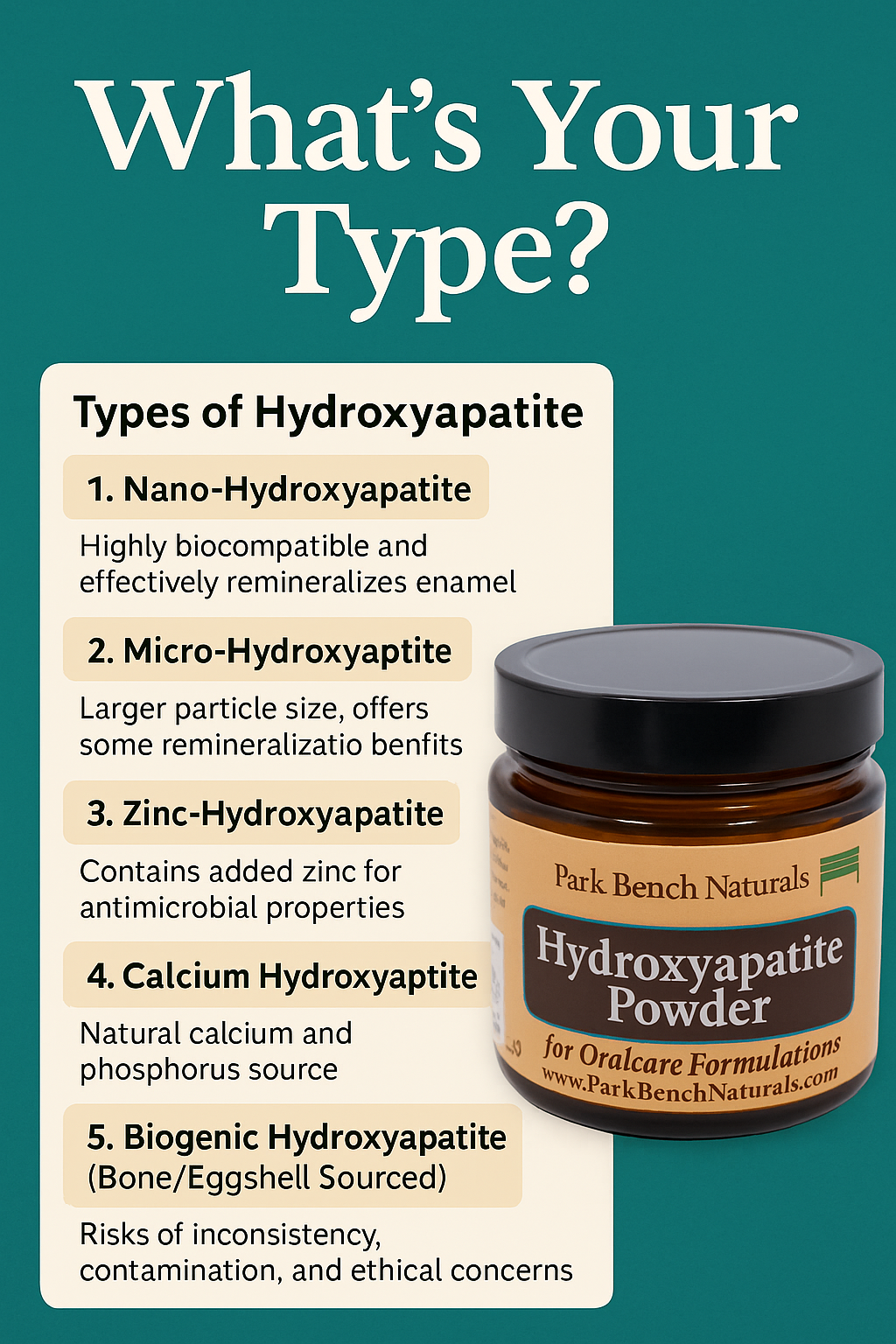
“Not all hydroxyapatite is the same. Here’s how to choose the safest, most effective type for stronger, healthier teeth — naturally.”
Not all hydroxyapatite is the same. From nano to micro, from animal-sourced to lab-made — the type you choose matters for your oral health. In this simple guide, we break down the differences and share why Park Bench Naturals trusts pure, synthetic hydroxyapatite for stronger enamel, reduced sensitivity, and fluoride-free protection.

Hydroxyapatite in Tooth Care
Hydroxyapatite in Oral Care: Which Type Is Best for Your Smile?
When it comes to strengthening enamel and reducing tooth sensitivity, hydroxyapatite (HAp) has become one of the most exciting ingredients in modern oral care. But not all hydroxyapatite is created equal. Different forms vary in size, purity, and source — and knowing the difference can help you make the healthiest choice for your smile.
At Park Bench Naturals, we believe in transparency and science-backed ingredients. Here’s a closer look at the types of hydroxyapatite you might see in oral-care products — and why we chose the one we use.
Types of Hydroxyapatite
1. Nano-Hydroxyapatite (nHAp)
These ultra-fine particles are small enough to integrate into microscopic enamel defects, making them highly effective for reducing sensitivity and remineralizing teeth. Research shows nHAp can mimic the structure of natural enamel more closely than larger particles.
👉 Best for: sensitivity relief, enamel repair, premium toothpaste and powders
2. Micro-Hydroxyapatite (mHAp)
Micro-sized particles are larger and coat the tooth surface rather than penetrating tiny tubules. They still support remineralization and are safe and biocompatible, but results for sensitivity relief are usually slower compared to nano.
👉 Best for: surface enamel protection, mid-range products
3. Amorphous Calcium Phosphate (ACP)
A non-crystalline precursor to hydroxyapatite, ACP occurs naturally in saliva and breast milk. It offers quick mineral availability for enamel repair, though it tends to be less stable and often requires stabilizers like casein (from dairy).
👉 Best for: pediatric or sensitivity formulations, when paired with stabilizers
4. Carbonated Hydroxyapatite
This modified form replaces some phosphate groups with carbonate, making it more similar to natural tooth mineral. It’s biologically familiar but less stable, especially in acidic environments.
👉 Best for: research, experimental products

5. Biogenic Hydroxyapatite (Bone/Eggshell Sourced)
Some brands use hydroxyapatite sourced from animal bones or eggshells. While this may sound “natural,” it carries risks of inconsistency and contamination. It also raises ethical concerns for people seeking clean, vegan-friendly oral care.
👉 Best for: low-cost formulations (but not our choice)
6. Synthetic Hydroxyapatite
Lab-engineered hydroxyapatite is pure, consistent, and safe. It avoids the risks of animal sourcing and allows for precision in particle size, whether micro or nano. This is the form trusted in scientific research and premium oral-care products.
👉 Best for: safe, effective, science-backed oral care
Why Park Bench Naturals Chooses Synthetic Hydroxyapatite
At Park Bench Naturals, we use synthetic hydroxyapatite because it delivers the best of both worlds:
- ✅ Pure and consistent — no animal bones or shells, no contamination risk.
- ✅ Science-backed — the same type used in ongoing dental research.
- ✅ Effective — supports enamel remineralization and sensitivity relief.
- ✅ Ethical and clean — aligns with our commitment to natural, sustainable, and safe products.
When you choose our tooth powders, you can trust that every jar contains premium, research-grade hydroxyapatite — made for stronger, healthier teeth without compromise.

hydroxyapatite because it delivers the best of both worlds
The Bottom Line
Not all hydroxyapatite is the same. From nano to micro, from animal-sourced to lab-made, the differences matter when it comes to your oral health.
✨ That’s why Park Bench Naturals proudly offers synthetic hydroxyapatite tooth powders — fluoride-free, clean, and designed to protect your enamel naturally.

Leave a Reply