
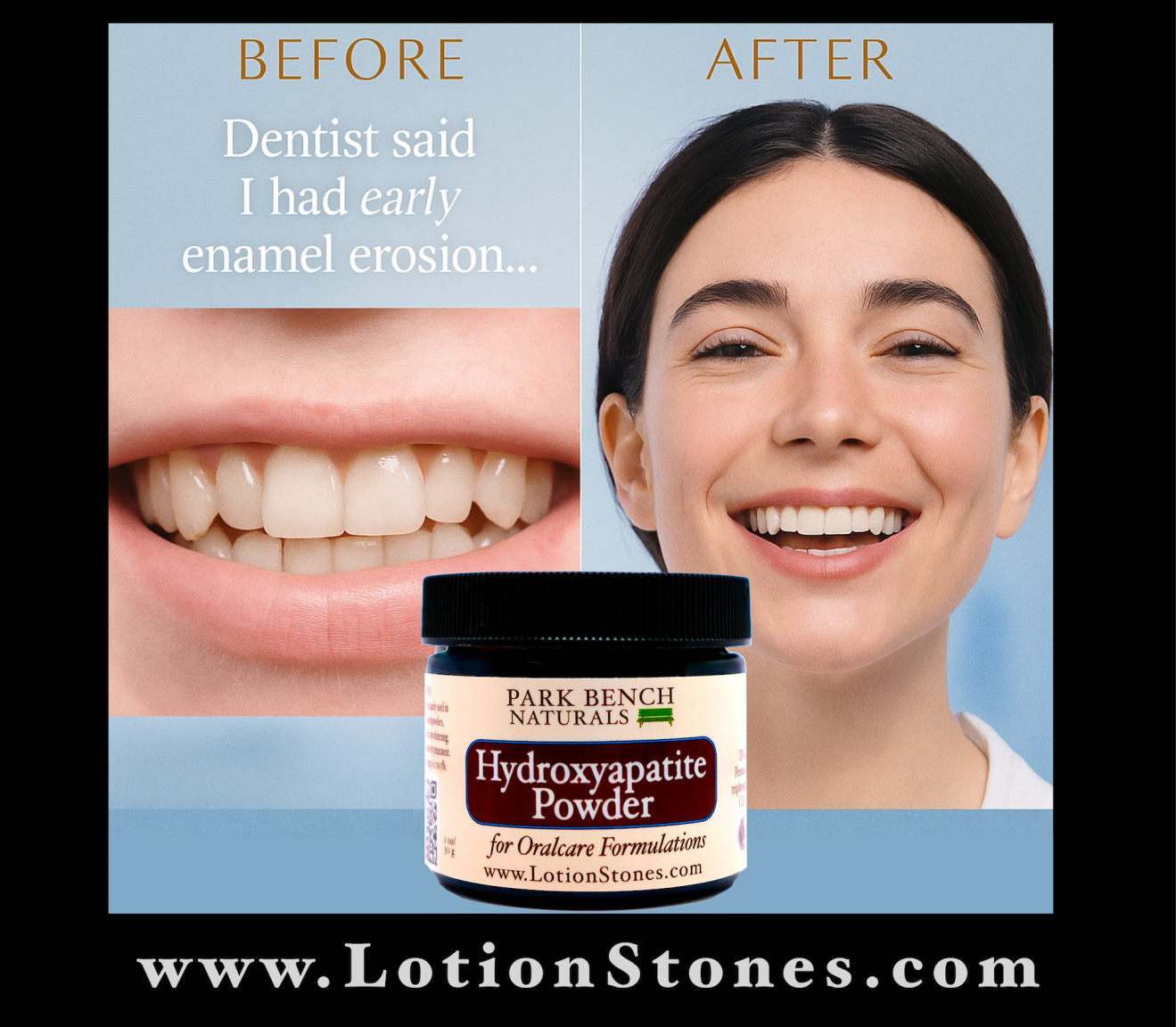
Park Bench Naturals is not alone in finally saying good bye to Fluoride, but many want to know what can be used instead. Is Hydroxyapatite the next big thing?
For decades, fluoride has been the bedrock of public dental health, celebrated for its cavity-fighting prowess and widespread use in toothpaste and water supplies. But what if the very solution we’ve relied upon comes with its own set of concerns, prompting a search for a safer, equally effective alternative? Is it time to say good bye to Fluoride.
In an era of increasing awareness about what we put into our bodies and communities, a powerful question is emerging: Is it time to say goodbye to fluoride, and could hydroxyapatite be the revolutionary, natural successor we’ve been waiting for?
At Park Bench Naturals, we believe the answer is a resounding yes.
The Growing Debate: Why Concerns About Fluoride Are Mounting
While fluoride has undeniably contributed to a reduction in tooth decay, an escalating conversation surrounds its potential downsides, particularly regarding its presence in drinking water.
Concerns often highlighted by health advocates and researchers include:
- Dental Fluorosis: This cosmetic condition, characterized by white spots or streaks on tooth enamel, is a clear sign of excessive fluoride intake during tooth development. While often mild, severe cases can lead to brown stains and pitting.
- [see more about Dental Fluorosis]

- Skeletal Fluorosis: A more severe condition, skeletal fluorosis results from long-term, high-level fluoride exposure, leading to bone and joint pain, stiffness, and in advanced cases, crippling.
- Neurotoxicity Concerns: Emerging research, though still debated, raises questions about fluoride’s potential impact on cognitive development, especially in children. These studies prompt a re-evaluation of current exposure levels.
- David C. Bellinger’s article, “Is Fluoride Potentially Neurotoxic?”, published in JAMA Pediatrics in 2019, addresses the ongoing debate surrounding the potential neurodevelopmental effects of fluoride, particularly in children. The article suggests that while research is still evolving, the potential neurotoxic effects of fluoride, especially on children’s neurodevelopment, are a legitimate concern that warrants further in-depth investigation.
- Lack of Control in Water Fluoridation: Unlike toothpaste, where fluoride intake can be controlled, community water fluoridation means individuals have little say in their exposure levels, particularly vulnerable populations like infants whose formula may be mixed with fluoridated water.
These concerns are not meant to dismiss fluoride’s past role but rather to foster an informed discussion about finding safer, equally effective alternatives that prioritize long-term health.
Enter Hydroxyapatite: The Safe & Superior Solution

This is where hydroxyapatite shines as a true game-changer. As Park Bench Naturals has extensively researched and championed, hydroxyapatite (HA) is a naturally occurring mineral that forms the primary structure of your teeth (97% of enamel) and bones. This inherent biocompatibility is its greatest strength.
Key Advantages of Hydroxyapatite (and Why It Has No Fluoride Concerns):
- Biomimetic Repair: Unlike fluoride, which primarily strengthens existing enamel, hydroxyapatite actively rebuilds and repairs enamel by integrating directly into the tooth’s structure. It fills in microscopic tubules and fissures, literally restoring the tooth.
- “At Park Bench Naturals, our commitment to natural health led us to hydroxyapatite because it doesn’t just protect; it restores your enamel using your body’s own building blocks,” says Jeanne Marcum, Founder, Park Bench Naturals.
- Unparalleled Safety Profile: This is perhaps the most compelling differentiator. Hydroxyapatite is non-toxic. Even if swallowed (a common occurrence with toothpaste, especially for children), it poses no health risks. Your body recognizes it as its own, and any excess is simply passed without harm.
- Based on the data provided, the SCCS [Scientific Committees on Consumer Safety] considers hydroxyapatite (nano) safe when used at concentrations up to 10% in toothpaste, and up to 0.465% in mouthwash.This safety evaluation only applies to the hydroxyapatite (nano) with the following characteristics:
– composed of rod-shaped particles of which at least 95.8% (in particle number) have an aspect ratio less than 3, and the remaining 4.2% have an aspect ratio not exceeding 4.9; – the particles are not coated or surface modified. [The exact characteristics of the hydroxyapatite powder offered and used by Park Bench Naturals]
- Based on the data provided, the SCCS [Scientific Committees on Consumer Safety] considers hydroxyapatite (nano) safe when used at concentrations up to 10% in toothpaste, and up to 0.465% in mouthwash.This safety evaluation only applies to the hydroxyapatite (nano) with the following characteristics:
- No Risk of Fluorosis or Systemic Issues: Because it’s biocompatible and non-toxic, concerns like dental fluorosis, skeletal fluorosis, or potential neurodevelopmental impacts associated with high fluoride intake are entirely absent with hydroxyapatite.
In my practice, the use of hydroxyapatite varnish has resulted in a significant decrease in the number of fillings and crowns I place on children. This translates to fewer anesthesia visits, reduced treatment time, and ultimately, a lower overall cost for both patients and insurance providers. Additionally, by arresting the progression of cavities early, we can prevent the need for more extensive and expensive restorative procedures down the line. Hydroxyapatite has also been shown to help modulate and optimize the oral microbiome, something fluoride cannot do.
– Anastacia M Whitman, DMD, IFMCPBoard-Certified Pediatric Dentist

4. Effective Cavity Protection & Sensitivity Relief: Studies consistently show hydroxyapatite to be as effective, if not more so, than fluoride in preventing cavities and significantly reducing tooth sensitivity by occluding exposed dentinal tubules. Here are some excerpts from an article found in Frontiers in Public Health
- Hydroxyapatite, Ca5(PO4)3(OH), is a calcium phosphate mineral that forms the mineral phase of human teeth and bone (1). Particulate biomimetic hydroxyapatite can be produced synthetically via different routes (2) and can be used for different purposes in medicine and dentistry (1, 3, 4). An important characteristic is its excellent biocompatibility and safety (3, 5). It is particularly useful in oral health as an active ingredient in oral care products, such as toothpastes (6–11), mouthwashes (12–16), and oral gels (17–19). Clinical studies have shown its efficacy in the improvement of periodontal health in patients with mild-to-moderate periodontitis (20), in the relief of dentin hypersensitivity (21, 22), and in other fields of application (23, 24).
- The modes of action of hydroxyapatite in the oral cavity are based on physical, biochemical, and biological principles (23). Two key mechanisms involved in how toothpastes prevent dental caries are inhibiting demineralization and remineralization of initially demineralized tooth surfaces (25). In this respect, several in vitroand in situ studies that investigated hydroxyapatite toothpastes have been published (26–28). It has been shown that hydroxyapatite toothpastes remineralize enamel and dentin (8–10, 29) and inhibit demineralization (9, 19). Additionally, clinical studies have shown caries-preventing effects (6, 7, 26). Caries studies comparing hydroxyapatite and fluoride are important as fluoride has been used in oral care as an anticaries agent for decades (25, 30). However, it is known that chronic exposure of fluoride from various sources (drinking water, oral care products, food, etc.) has certain drawbacks. Fluoride can cause dental fluorosis and other side effects (31–35). As a consequence, the concentration of fluoride in toothpastes is limited and children up to 6 years are only allowed to use small amounts of toothpaste (pea size, grain of rice size) (36, 37). Reduced toothpaste amounts can lead, however, to a reduced cleaning efficacy compared with larger toothpaste amounts (i.e., full length of brush) (38).
Why Park Bench Naturals is Leading the Hydroxyapatite Revolution
At Park Bench Naturals, our mission is to provide effective, safe, and truly natural solutions for your health. We saw the growing need for a superior alternative to fluoride and invested deeply in understanding and harnessing the power of nano-hydroxyapatite.
Our formulations are meticulously crafted to ensure the optimal size and concentration of hydroxyapatite particles, maximizing their ability to repair and protect your enamel without compromise. We believe in transparency, scientific rigor, and providing you with oral care products you can trust wholeheartedly.
“Every Park Bench Naturals product is born from extensive research and a commitment to pure, effective ingredients. With hydroxyapatite, we’re not just selling toothpaste; we’re offering a pathway to truly natural, resilient oral health,” says Founder and Product Developer Jeanne Marcum, at Park Bench Naturals.

The Future of Your Smile: Naturally Strong, Naturally Safe
The debate around fluoride is complex, but the path forward for safer, more effective oral care is clear. Hydroxyapatite represents a paradigm shift—a return to nature’s own wisdom, backed by modern science.
It’s time to consider a future where your toothpaste doesn’t just clean, but actively rebuilds; where safety is a guarantee, not a concern. It’s time to explore the power of hydroxyapatite.
Explore Park Bench Naturals’ range of hydroxyapatite oral care products and experience the future of dental health today.

Leave a Reply